

What is HDR? What does HDR stand for?

What is HDR? What does HDR stand for?
As display technologies on the market become more sophisticated, the evolution of technology has opened up various display options for us. As a widely used display technology, HDR is currently widespread. When choosing a monitor, we need to have the corresponding basic knowledge to better select the screen.
What is HDR?
What does HDR mean? HDR is a processing technology that enhances the brightness and contrast of images. This technology can enrich the details of every dark part, make dark areas darker, and enrich more detailed colors, so that movies, images, and game screens can all present excellent images. The effect brings users closer to the visual experience in the real environment when watching movies and playing games. The maximum brightness of conventional SDR (Standard Dynamic Range) is only 100 nits, the image part above 100 nits will be distorted (lost), the minimum adjustment is 0.1 nits, and the image part below 0.1 nits will be distorted (lost). With HDR technology, the highest brightness can reach thousands of nits and the lowest brightness can reach 0.0005 nits, which significantly expands the details of the parts with brightness greater than 100 nits and less than 0.1 nits in the image, making the whole picture appear more transparent, bright, and detailed. Just like our 4K HDR Monitor offers you a high-quality and vivid picture.
HDR stands for High Dynamic Range and can display a wider range of brightness (dynamic range) – from the darkest to the brightest – than the existing SDR (Standard Dynamic Range).
As shown in the image below, when displaying content in SDR, blacks appear crushed in the shadows, while whites appear washed out in bright areas. while HDR allows for a more natural, lifelike representation without diluting the bright or dark hues of the area.
HDR is attracting attention as the next generation of high-quality image technology, and content produced in HDR format is now available via video streaming services like Netflix and UHD Blu-ray Disc.
 SDR – crushed black in shadows
 SDR-white in bright areas is washed out
 HDR
HDR
What does HDR mean? HDR Principle
The brightness of our screen cannot achieve the brightness that can perfectly restore the color information in the material, and the processing of brightness information in the HDR video that exceeds its brightness display range will result in an overexposed or too dark image. For televisions, the solution is to significantly increase the screen brightness. Currently, HDR televisions require a maximum brightness of at least 1000 nits and a minimum brightness of at least 0.05 nits.
However, the usage distance limitation of computer monitors directly limits the brightness range of the monitor (monitor brightness above 500 nits will cause damage to the human eye), so the way to achieve HDR for computer monitors is not the same as for televisions. The HDR support chip in the HDR display is used according to the display parameters. It analyzes the HDR content, extracts the brightness information, and performs tone mapping for the information in the HDR content that exceeds the display's dynamic range and color (for strong contrast attenuation). Change the brightness of the scene to the range that can be displayed, while preserving image details and colors that are very important for expressing the original scene), the monitor screen highlights every exposure detail of the HDR film source in the displayed image.
According to this principle, the details of the highlights in the film source can be displayed more clearly, thereby improving the image quality and making it more realistic. Getting HDR Monitors will definitely enhance the experience, whether you are watching movies or playing games.

Five Elements of High Picture Quality
These five elements influence the quality of the image
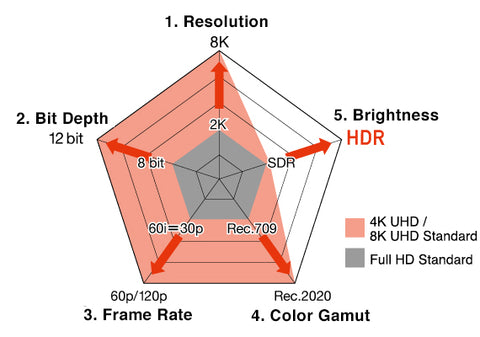
Among these, resolution, bit depth, frame rate, and color gamut have been standardized according to the 4K/8K UHD broadcast standard BT.2020. *Only the brightness standard remains at 100 cd/m² of the Full-HD broadcast standard BT.709, without improvement.
For this reason, previous production efforts required compressing parts of high-brightness images to adapt them to the characteristics of display devices, which led to displayed images that differed from the original scene.
In recent years, however, advances in display technology have led to an increase in the displayable dynamic range, allowing brightness and color reproduction to truly resemble those in the real world. This is why HDR has attracted so much attention recently.
1.Resolution = Fineness of image details
Resolution refers to the number of pixels in an image. The higher the resolution, the more pixels are available for a given screen size, resulting in finer details. The 4K UHD resolution is 3840 x 2160, which means four times the displayed image data of standard Full HD.
 2k
2k
 4k
4k
 8K
8K
2.Bit Depth = how fine the color gradient is
Bit depth refers to the number of colors each pixel can display. The greater the bit depth, the more colors can be displayed, resulting in smoother, more natural color gradients. For example, an 8-bit monitor can display approximately 16.77 million colors, while a 10-bit monitor can display approximately 1.07 billion colors.
 8-bit display
 10-bit display
3.Frame Rate = Smoothness of motion
Frame rate refers to the number of frames displayed in one second. Movies usually have a frame rate of 24p (24 frames or images per second), while normal television usually has a frame rate of 60i or 30p (30 frames per second).
The 8K broadcast standard BT.2020 includes the definition of frame rates (up to 120p) where motion is almost as smooth as in the real world.
 30p = 60i
 60p
60p
 120p
120p
4.Color Gamut = how vibrant the colors are
Color gamut refers to the range of all displayable colors. The diagram on the right shows the range of all RGB values that the human eye can perceive. The triangles represent the color gamut: the larger the triangle, the more colors can be displayed.
The 4K/8K broadcast standard BT.2020 (Rec.2020) covers a larger color range than the existing Full-HD broadcast standard BT.709 (Rec.709).

5.Brightness = Intensity of image illumination
Brightness refers to the range of image illumination intensity that can be displayed. The range of difference between the darkest and brightest objects that the human eye can perceive (dynamic range) is typically 1012, while conventional display devices can only display a dynamic range of up to 103. HDR extends the dynamic range to 105 to 100 times that of current display devices – allowing light and shadows to be displayed in a way that is closer to what the human eye perceives.

What are the standards for HDR?
There are six different standards: HDR10, Dolby Vision, HDR10+, HLG, Advanced HDR by Technicolor, and DisplayHDR.
What is HDR10?
HDR10 proves to be the most common HDR on the market. It is an open standard that has been adopted by many service providers, such as Amazon and Netflix. According to CEA (Consumer Electronics Association), hdr10 must meet certain standards, including 4:2:0 chroma subsampling, 10-bit color depth, and BT.2020 color space, which is the general rule of HDR and the most basic HDR standard.
HDR10 is the standard pushed by the UHD Alliance. It is a technical standard with defined ranges and specifications that must be met for content and displays to be eligible for use. HDR10 uses static metadata that is consistent across all displays. This means HDR10 videos specify light and color levels in absolute values, regardless of the screen they are displayed on. Being an open standard, any content producer or distributor can use it freely. Every service with HDR content supports HDR10, usually alongside Dolby Vision or another HDR format.
What is HDR10+ ?
Samsung’s HDR standard. Just like Dolby Vision HDR, Samsung's HDR technology uses dynamic metadata in compatible content to upscale the HDR image frame by frame. It builds on HDR10 and adds dynamic metadata like Dolby Vision. It doesn't use individual metadata for each screen, but still adjusts the light range the TV should display for each scene or image. It can potentially add more detail to your image than HDR10 shows, and like HDR10, it's an open standard that doesn't require a license with a very specific production workflow. Amazon Prime Video is the first content provider to announce HDR10+ support and live broadcasting in HDR10+ mode, providing more than 100 shows such as “The Man In The High Castle” and “Grand Tour”.
What is Dolby Vision ?
The main difference between Dolby Vision and HDR10 is that HDR10 applies its parameters from scene to scene, but Dolby Vision allows dynamic metadata to complement and adjust the HDR image frame by frame. In theory, Dolby Vision can process images more subtly and improve image quality, but in reality, image quality depends on how well the movie can utilize this technology. Currently, some Sony movies use Dolby Vision.
Among other things, Dolby Vision differs in that it is designed as an end-to-end HDR process. From capture to processing to production, Dolby Vision is designed to preserve and transmit the originally captured information. This is done using metadata, which is then read by the Dolby Vision decoder on the TV you are currently watching. The goal is to provide you with an HDR experience that is closer to the original by providing more information – and it does this through the use of dynamic metadata.
What is HLG ?
Hybrid Log-Gamma (HLG) isn't as common as HDR10 or Dolby Vision, and outside of some BBC and DirecTV broadcasts, there's very little content for it so far, but it could make HDR much more widely available. That's because it was developed by the BBC and Japan's NHK to provide a video format that broadcasters can use to transmit HDR signals (and SDR; HLG is backward compatible). It's technically more universal because it doesn't use any metadata at all. Instead, it uses a combination of the gamma curve that TVs use to calculate brightness for SDR content, and a logarithmic curve to calculate the much higher brightness levels that HDR-capable TVs can produce (hence the name Hybrid Log-Gamma).
What is Advanced HDR by Technicolor ?
Advanced HDR by Technicolor is a newer HDR format that was introduced at CES (International Consumer Electronics Show) in 2017. It is the result of a collaboration between LG and video specialist Technicolor, but LG is currently the only company supporting the format. However, the official did not release any specific news or supported content for its HDR.
What is DisplayHDR ?
This is the Video Electronics Standards Association (VESA) HDR standard for PC monitors. DisplayHDR Version 1.0 is divided into three tiers based on features such as lumens, color space, color depth, and rise time: DisplayHDR 400, DisplayHDR 600, and DisplayHDR. 1000. Currently, the DisplayHDR certification specification applies only to LCD displays for now and does not apply to OLED panels, nor is compatibility with existing HDR content and games guaranteed. This standard was only released at the end of 2017. It is expected that more display manufacturers will adopt this standard in the future, but this standard only targets the hardware capabilities of the display.



Leave a comment