

QLED VS OLED, which is better?
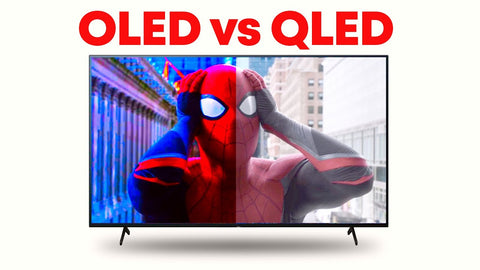
Buying a new TV in 2022 is as confusing as it has been in the past. QLED and OLED are two of the most common TV acronyms. While separated by only a single letter, the technology they describe couldn't be more different.
As the leading manufacturer of QLED TVs, Samsung has been known for marketing its televisions under the QLED moniker for several years. On the other hand, we have OLED TVs, a market that has been dominated by LG in recent years.
So what is the difference between OLED and QLED? Let's first look at what each of them means.
|
Table of contents[Hide]
|
What is OLED?
OLED TVs use organic light-emitting diodes. They represent a completely different type of display technology than QLED TVs, which use LCD panels.
An OLED TV eliminates the need for backlights. Instead, in an OLED, each individual sub-pixel can create its own light source. This allows for finer control over contrast and dark levels than QLEDs.
Unlike QLED TVs, OLED displays typically do not use quantum dots. However, the first "QD-OLED" TVs from Sony and Samsung will be launched later this year (2022). These TVs are still based on OLED technology but have improved color performance due to the addition of quantum dots.
What is QLED?
QLED TVs are simply LCD (liquid crystal display) TVs with quantum dot color technology. Like other LCD TVs, these displays rely on a light-emitting diode (LED) backlight to illuminate their screens.
Manufacturers combined the "Q" from "Quantum Dots" with the "LED" in "QLED" to create the brand. While "QLED" may be useful for marketing purposes, it doesn't actually refer to a specific TV technology.
In other words, a QLED TV is simply an LCD TV with LED backlighting and additional quantum dots. In fairness, however, quantum dots are a nice feature that can significantly improve picture quality. Nanocrystals known as "quantum dots" can change color when struck by light. Quantum dot filters or layers are integrated into QLED TVs to help them provide a wider color gamut.
Difference between OLED and QLED
Now that you know what all these letters stand for and what they mean in terms of display technology, let's compare QLED to OLED in the areas that matter most when buying a TV.
Given the significant cost of buying a new TV, it's important to consider factors like contrast, brightness, viewing angle, and other important performance aspects such as response speed and durability.
Here's an in-depth comparison between OLED and QLED TVs so you can choose without hesitation.
Black Level and Contrast
When looking for a new TV, a good contrast ratio should be at the top of your priority list. However, if you're unfamiliar with contrast, here's a brief explanation.
A TV's black level controls how dark the darkest image can get. This can be anything from true black to very dark gray on a TV. The contrast between dark and bright areas of the image is strongly influenced by these nuances. The darker background and brighter colors create a more realistic impression.
OLED displays have millions of individual pixels, each of which can create or illuminate a different color. When a pixel displays a completely black image, it's virtually out of commission. So the image is actually pitch black. The result is a striking contrast between bright and dark images.
In every scene, the QLED screen's backlight becomes either brighter or darker. The screen's ability to dim more subtly in certain areas depends on the total number of lights. QLED TVs are starting to catch up with OLED TVs in terms of black level performance, although OLEDs still have the edge.
Color Volume and Brightness
A TV's color volume is the sum of its color depth and peak brightness. High TV color volume is particularly important when watching High Dynamic Range (HDR) content. In addition to a wide color gamut, HDR images typically feature vibrant hues. These hues are only visible on a TV screen if the brightness is set quite high.
Thanks to HDR technology, more than a billion different colors are available on every OLED TV. Compared to a QLED TV, the brightness performance of an OLED TV is significantly lower. Therefore, the full potential of certain color tones is not exploited. Keep in mind that colors will appear duller in a well-lit room. It is ideal to watch in a dark environment so that the colors and contrast can be properly appreciated.
A QLED TV's superior performance in both categories is due to the use of Quantum Dot technology. Tiny nanocrystals are at the heart of this technology, which uses light to produce a range of colors. QLED TVs achieve perfect color volume in this way. Whether it's a field of flowers or an animal's fur, every nuance of color is captured precisely. Images with similar brightness are also clearly visible in a well-lit room.
Viewing Angle and Reflection
The viewing angle is a very important factor in modern TVs. It determines how far you can sit sideways without the image quality deteriorating. Annoying reflections can be seen from any angle, but they are most noticeable when viewed from the side or front. The screen becomes reflective when illuminated from behind by light sources such as the sun or a lamp. This problem affects some TVs more than you might think.
The wide viewing angle is one of the most remarkable features of an OLED TV. The viewing angle has no effect on picture quality, so you can sit at an angle. Colors and brightness only start to change when you view the device from an angle of about 85 degrees.
A QLED TV's viewing angle is narrower than an OLED TV's. Colors begin to shift and brightness decreases significantly from an angle of about 55 degrees. QLED TVs have the advantage of showing fewer reflections. The backlight and anti-reflective coating of the screen prevent unwanted glare. This ensures that the screen remains readable even in direct sunlight or artificial light.
Response Time and Refresh Rate
Response time is the time it takes for a pixel to switch between states. A faster response time means better picture quality, which is especially useful when watching action movies.
Standardized measurements show that OLED TVs are much faster, although there's probably a response speed where the human eye can't tell the difference.
QLEDs typically have a response time of 2-8 milliseconds, which seems great until you learn that OLEDs typically have a response time of 0.1 milliseconds.
Another metric that is naturally more important for Gaming Monitor 4K Gamers than for casual viewers is refresh rate. Your TV's refresh rate indicates how often it refreshes in a second. Like the frame rate of a video game, it increases with the refresh rate. Here, OLED TVs emerge as the winner.
Pixel Response
Pixel response time is the time between a user sending a command to a controller and the corresponding image appearing on the screen. QLED panels aren't as fast as OLEDs in terms of pixel response time, but they're usually on par with OLEDs in terms of the number of frames they can display (120Hz is currently the peak at 4K).
OLED 4K monitors often have a response time of 0.2 milliseconds or less due to the separate control of each pixel, but QLEDs are rarely faster than one or two milliseconds. In competitive gaming at the highest level, even a fraction of a second can have a significant impact. When it comes to the speed at which individual pixels update, OLED is currently at the forefront.
Lifespan
Lifespan is the last comparison metric we'll look at. Like traditional LCD TVs, QLED TVs use a liquid crystal layer in conjunction with LED backlight technology. The effectiveness and durability of LEDs have been well documented for many years.
Furthermore, the quantum dots in QLED TVs do not degenerate over time, meaning they do not crack or lose brightness. This protects them from burn-in and ensures a longer lifespan.
However, due to their self-emitting nature, OLED TVs are more susceptible to burn-in. Burn-in occurs when the typical brightness of one or more OLED pixels is permanently reduced to a lower value. The only option is to adjust the brightness of every other pixel, which is hardly ideal.
Wrapping Up
Both OLED and QLED display TVs offer excellent picture quality. An OLED TV is a great choice if you're looking for the deepest blacks. The black levels are spot on, as each pixel is individually deactivated. If color vibrancy and brightness are most important to you, consider a QLED TV. These TVs offer stunning color intensity, especially when watching HDR content.






Leave a comment